Blog Posts

All For Naught

This month in the Datalexic crossword series brings a puzzle titled “All For Naught” that has some bite to it. Enjoy!

And if you’re new to Datalexic crosswords, a friendly invitation to sign up for the mailing list, over on the left sidebar—a new puzzle will get delivered fresh to your inbox every 1st of the month.

[puz] [pdf] [solution]

Famous Names

New year, new start to a monthly puzzle series. This themed puzzle is titled “Famous Names” and brings you a take on a few of them. Enjoy!

And speaking of puzzles, my published debut is now available through the wonderful AVCX. Big thanks to the editorial team there for generously guiding me through the process!

[puz] [pdf] [solution]

Cattle Callings

Welcome to a sneak peek at Datalexic’s upcoming crossword series. Today’s themed midi “Cattle Callings” winks at the holiday season. I’ll be posting a puzzle on the first of every month, plus a bonus themed midi puzzle on occasion. Enjoy!

Note: My themed midis are going to focus on 11x-ish crosswords with 2-3 theme answers and an optional revealer. Perfect for those theme ideas that don’t quite work as full puzzles, but still provide some bite-size word play.

[puz] [pdf] [solution]

IFComp 2019 Reviews

The 2019 IFComp marks its 25th anniversary with a record number of entries ranging in scale, format, and theme. After playing about a dozen that intrigued me, mainly choice-based games with play times under one hour, I’ve put together a list of my top 5 from the competition.

*Warning: The below reviews may contain spoilers!

1. The Good People

Rating: 9/10

The Good People is a beautifully written and designed, emotional, and very personal story about a man and his girlfriend exploring the ruins of a town where his ancestors once lived, in a region that he escaped from years ago, with memories and supernatural occurrences arising the further in they get.

Varying font sizes and the use of spatial areas on the page, representing the jumbled thoughts of the protagonist as he navigates the ruins, are very effective at marking the different regions of his mind that are in conflict with each other. Does he want to find out more about his past, or repress his memories? Does he want to connect with his girlfriend, or ignore their communication problems? The images used for the village are also evocative, representing the sketched quality of its ruins and memories that feel half-formed and ethereal, existing in a liminal space that is occasionally embodied with compellingly menacing mythological figures.

The choice structure also feels closely tied to the difficulties of communication. Occasionally, we want to nudge the protagonist toward feeling comfortable enough to open up to his girlfriend, but the choices end up leading to self-sabotage no matter what we select. At other points, opportunities do open up for meaningful connection if the protagonist is willing to listen and be honest about the difficulties he’s facing in confronting his past. It feels like we’re observing a real relationship, with it’s small moments of sarcasm and anger, or comfort and kindness. This allows the culmination of the story, which involves some supernatural twists, to feel fully earned.

There are occasional moments when language or word choice indicate that the writer isn’t a native English speaker, but a fitting explanation of this is given as the protagonist is an expat who occasionally struggles to speak his girlfriend’s language. I loved how this also tied to broader themes of straddling two worlds, having shame around your origins, and the struggle of not always being able to put these things clearly into words.

The deftness of the writing, mythology, story structure, and themes, in concert with the beautiful use of interactivity and visual design, make this my favorite piece of the competition.

2. Night Guard / Morning Star

Rating: 9/10

Night Guard / Morning Star explores haunting themes around the sacrifices that are sometimes made in the service of art as well as the difficulties of living in the shadow of a self-centered parent. These themes are beautifully rendered through scenes where paintings come to life in ways that illuminate the protagonist’s past, revealing and developing the characters through off-kilter, scattered memories.

It’s a wonderful example of interactive structure serving the story, as the physical layout of the gallery, the description cards for all the paintings, and the ability to enter paintings in order to explore a scene from the past, all fit tightly and satisfyingly with the dark and vivid story being told.

The characters also pop amazingly well. The aunt and the Morning Star are vividly rendered and memorable as their images become embodied in different ways while they beckon and cajole the protagonist into action. And the relationship between the protagonist and her mother is deliciously fraught: the protagonist is able to see conflicting perspectives she and her mother had on different moments in the past, and this, along with their occasional clashes during the course of the story (over the phone and eventually in person), lead to real character development and multiple endings that each feel like a unique yet earned resolution of the protagonist’s journey toward empowerment, as well as a (literal) exorcism of the ties and memories that have haunted her for a long time.

I also appreciate the fact that this piece seems to have been edited down to the essentials, fleshing out the characters and capturing every necessary story beat in exactly as much space as needed. The story clocks in at half an hour of play time, quickly picking up speed and maintaining momentum in the storytelling while still providing a rich, complex, and satisfying literary meal.

3. robotsexpartymurder

Rating: 8.5/10

robotsexpartymurder is a game I didn’t get to complete, since it takes longer than two hours, but even with where I ended up (I’m guessing around the midpoint) it feels like a successful pastiche of a surprising variety of genres: a visual novel-esque dating sim, a dystopian prison/workplace simulator, and a dialogue-based murder mystery. It ties these experiences together into a hilarious package with tightly written prose, a fast pace, and nary a dull moment.

The game pushes the envelope in terms of design, graphics, and music, with a very strong point of view: a theme of blue on black and retro looking fonts that feel like throwbacks to a 90’s vision of a cybernetic future, as well as a UI that’s framed within what looks like an old computer terminal linking together different options accessible to the player throughout the game.

The choice structure mixes the IF dating sim and murder mystery genres in a way that I hadn’t seen done to this degree, and they fit together very nicely. The same conversations where the main character is trying to get information out of the androids present opportunities to advance relationships with them, although I’m not yet sure how those relationships will factor into the endgame. Also, the use of choice structure to convey sex scenes as lists of clickable items with resulting sound effects is hilarious; more generally, the freewheeling approach to mature themes has just the right tone and avoids either prudishness or sleaziness, which I applaud.

While I mostly gravitated toward shorter interactive fiction experiences in this competition, this game was gripping enough to hold my attention, and then some. I’m looking forward to continuing on and seeing how the killer sex robot mystery plays out.

4. Dull Grey

Rating:  7.5/10

Dull Grey is an intriguingly dark and fatalistic piece, with a main character who seems unable to control his own destiny. It’s a beautifully designed experience in terms of presentation, with a gray-scale palette illustrating a bleak landscape in what appears to be a post-apocalyptic world, remnants of robots scattered around and a cult-like, fire-based religion hinted at throughout.

In terms of interactivity, it uses an interesting mechanic wherein the same binary choice is presented at each decision point. The repetitiveness fits well with the theme and setting, and the progression also builds in a powerful way as we follow a map and travel from scene to scene toward a momentous decision in the protagonist’s life, in a way that feels inevitably hopeless. The writing also leans into this with short, terse sentences and deadpan evocations of death, disaster, and a world seemingly on its last legs.

My first play-through (choosing lamplighter at each step) felt like the most fitting, as it created a strong characterization of the mother as obstinate yet resilient, sticking with tradition in a world that has become increasingly difficult to navigate. I was somewhat disappointed that this led to an “unhappy” ending, but was intrigued to find out which combinations of answers would lead to “happy” ones.

Different paths through the story presumably depend on the characters present at each decision point being more amenable to one option or another (lamplighter vs. tallyman). While I like this idea in theory, in the couple of replays I tried it felt like the sequence of scenes remained very linear regardless of choice, and I didn’t feel a connection to the decisions or any real sense of where they were leading me. Perhaps the game requires many replays to understand the subtleties, but the repetitiveness and linearity of the scenes made it difficult to remain motivated to continue replaying further.

This is a piece that resonates in terms of mood, setting, writing, and art design, with just the interaction/replay aspect as the element that wasn’t quite as satisfying for me as I would have hoped. However, it stands out as a unique and memorable entry in the competition.

5. Faerethia

Rating: 7/10

Faerethia has a novelistic and cinematic quality that I enjoyed. There’s a lovely mix of philosophy, human experience, and speculative scenarios, all sketched out in a short amount of space and written in a sure hand. As a multimedia short story, it’s also nicely rendered through silent movie inter-titles and the framing of vignettes interspersed throughout the piece, along with variations in font and background.

The themes of the story came through poignantly for me, especially in the dialogues between two unnamed characters that appear in a few sections. While the notion of this sort of technologically achieved utopia has been covered many times before, the writing was fresh and the emotional stakes high, leading to a satisfying ending.

In terms of the interactive elements of the game, I enjoyed the sections that explored Faerethia as well as the interview with the computer, both of which used light amounts of interactivity in effective ways. Some of the other satirical asides—the mini-game and the eye-winking descriptions in the paradise creation software—were amusing, but sometimes felt distracting and tonally at odds with the rest of the story.

Still, I found this to be a compelling piece of writing, and I’m left with the desire to delve into further philosophically tinged stories by this author.
Twine Story Clustering

In Twine-authored interactive fiction, one can find a wide range of structural approaches to storytelling through hyperlinked passages.

As explored in posts by Emily Short on small-scale structures and Twine gardening or by Sam Kabo Ashwell on standard patterns in choice-based games, as well as the work in Porpentine’s Twine Garden blog and the DotGraph project, full or partial story graphs can be useful both as a writing tool for authors, and as a way to reason about patterns of narrative structure in general.

Using twine-graph, a Python package developed to automate the creation of structured representations and visualized graphs for published Twine stories, I ran a meta-analysis of Twine stories based both on structure and on textual content.

I pulled all Twine stories published as part of the IFComp and Spring Thing competitions dating from 2012 onward (159 total stories) from the Interactive Fiction Archive, under the competitions’ terms that make all stories freely available upon entry. These were then processed into a dataset of structured representations and visualized graphs, and finally run through clustering analyses based on both structural and textual features.

Story Clustering with Structural Features

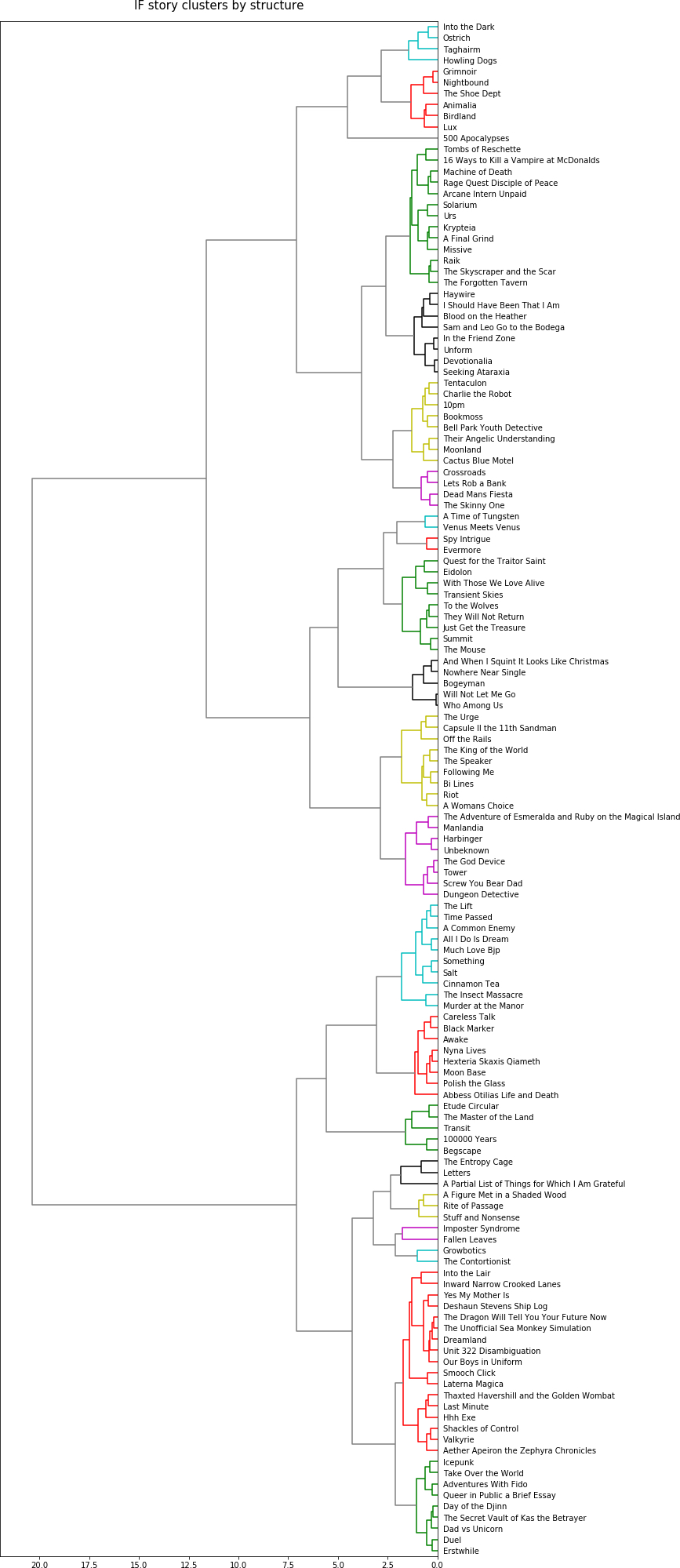
For structure, I used NetworkX to produce a number of features from each story’s graph structure: number of nodes, link degree (mean, median, and max), graph radius, and graph diameter. Given these features, the stories were passed into an algorithm for hierarchical clustering with SciPy to generate a dendrogram showing how stories group together according to similarities in their structure.

Looking at some of the stories clustered together according to structure, some interesting patterns arise. The visual representations of the stories Will Not Let Me Go (2017) [visual] and Who Among Us (2013) [visual], for instance, show clear similarities: both are fairly linear narratives with light branching and occasional denser interactive moments.

Story Clustering with Textual Features

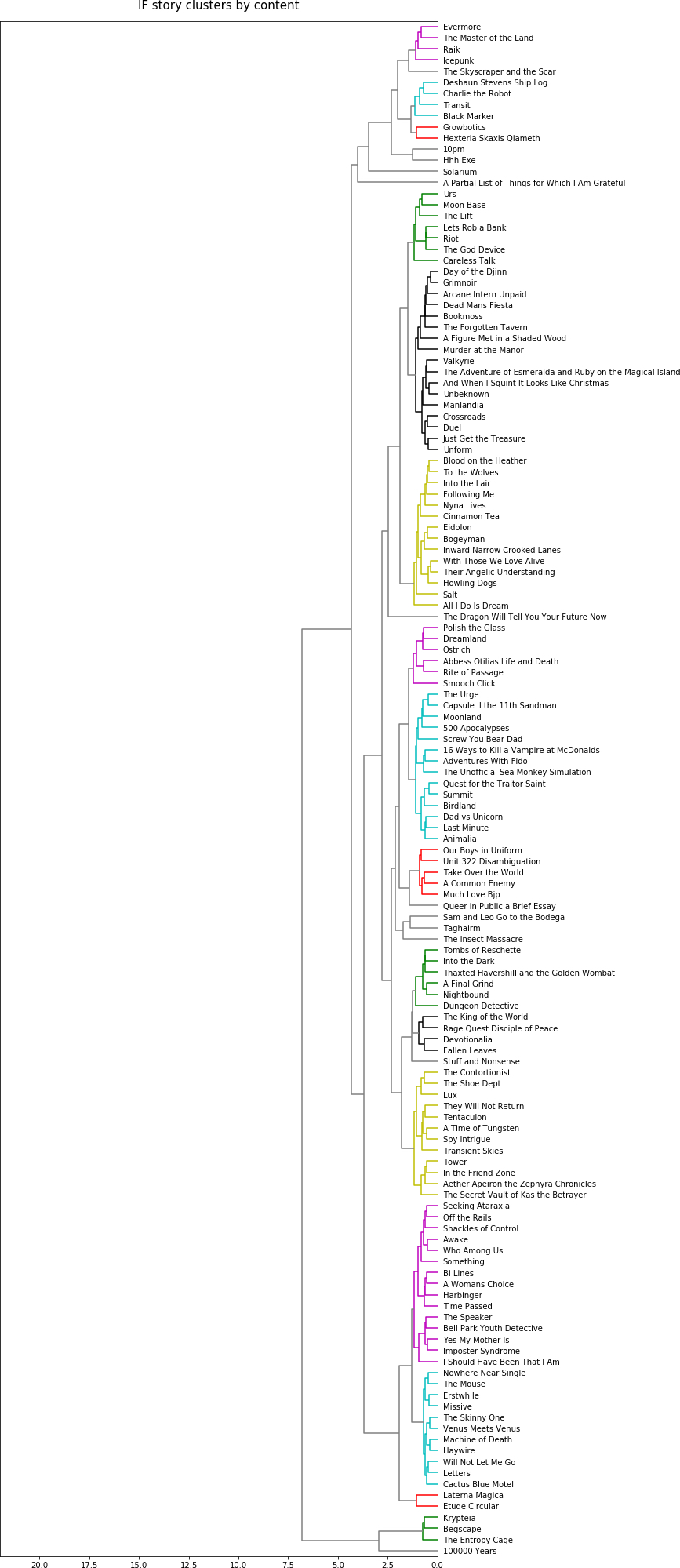
Given that each story’s passage text was available, I also ran a clustering analysis based on textual representation, to get at content and subject matter. This involved using spaCy to preprocess each passage, removing stop words and transforming each story into a word embedding space (using GloVe vectors) to facilitate hierarchical clustering.

The clustering changes substantially when using this semantic space, leading to nice results. For instance, the three stories authored by Porpentine—howling dogs (2012), their angelic understanding (2013), and With Those We Love Alive (2014)—are clustered together, which makes sense given that the author has a uniquely poetic and enigmatic writing style with content matter focused on the surreal and monstrous. Another interesting cluster appears to cover dark fantasy, magic and the macabre, and includes, among other stories, Day of the Djinn (2017), Grimnoir (2018), and Arcane Intern Unpaid (2015).

The full dataset, including graph visuals and structured representations of each story in the corpus, is available on GitHub, for any who are interested in browsing through specific visualizations or running other types of experiments. The analysis notebook used to produce the above plots is also available, and was written using Jupyter.

Introducing TwineGraph

Twine Graph is a Python package and command line tool for parsing passage and link structure from published .html Twine stories and outputting the resulting graphs in visual (.pdf) or structured (.json) formats. The goal of Twine Graph is to allow for research and analysis of story structure in freely-available Twine games.

The initial release is now available through PyPI under the name twine-graph, and the source code is available on GitHub.

Story Visualization

To demo Twine Graph’s capabilities, let’s look at two recent, highly rated Twine stories from the annual Interactive Fiction Competition (IFComp). Cactus Blue Motel (2016) is a game that involves a large amount of movement between the rooms of the titular motel, while Will Not Let Me Go (2017) is a more linear story that moves from scene to scene with only a few clusters of densely interlinked passages.

The twine-graph command line utility takes a published .html Twine file as input and programmatically derives a directed graph structure of passages and links. It outputs a structured .json file and corresponding graph image file, with the nodes laid out according to heuristics encoded in the graphviz library. The automatic layout appears to work well for many Twine stories, creating a top-to-bottom flow with nodes clustered into visually coherent sections.

In Cactus Blue Motel, the start and end sections are apparent, along with an interesting mid-game containing large clusters of highly-connected nodes indicating distinct explorable areas. [Visualization]

In the case of Will Not Let Me Go, the flow of the story is more linear, with only a few occasional clusters of nodes for scenes that focus on interlinked passages and choices. [Visualization]

Corpus of Twine Stories

In order to unveil insights into Twine story structure on a larger scale, I’m working on putting together a corpus of story files in .json and .pdf formats for all of the freely available Twine games that have been submitted to both IFComp and the Spring Thing festival since the inception of Twine games in those competitions, which goes as far back as 2012. I’m excited about the possibilities that this data will open up for the IF community to research and analyze choice-based game structure.

IFComp 2018 Reviews

The 2018 interactive fiction competition has brought together a range of games covering different formats, themes, and play times. After playing about a dozen that intrigued me, focusing primarily on choice-based games, I’ve compiled reviews for my top 5. *Warning: The below reviews may contain spoilers!

1. Bogeyman

Rating: 9/10 Bogeyman is a deeply disturbing and successful piece that takes a malleable entity from folklore and embodies it in a specific setting, casting the creature as a sadistic paterfamilias who employs psychological and physical abuse to ensure the children he abducts remain “good”. The design choices for the game are bold and effective, without overshadowing the story. These include a white-on-black palette, text fade-ins, spooky images during chapter breaks, and a haunting, thrumming soundtrack. If they were removed, the story would remain strong on its own, but they provide a great added touch. The choice-based flow of the game is relatively linear, with short passages that move the reader through the story quickly and smoothly. Every passage adds to the dramatic tension, slowly piling on indignities small and large, flowing through days of quotidian chores and tasks that range from the banal to the grotesque, all in the service of building a complex portrait of life under a tyrant whose moods and reactions are often unpredictable. An undercurrent of tension about what fates await the children, as well as an occasional glimmer of hope for escape, ratchets up from chapter to chapter, ensuring that the reader remains hooked to the very end. The game is able to deftly tackle a number of themes ranging from abuse to the nature of punishment and whether complicity is ever morally acceptable, all while delivering a gripping story with moments where it’s often as difficult to look as it is to look away.

2. + = x

Rating: 7/10 + = x is a story about hurtling through the galaxy at some point in our planet’s future, where a sinister sorting device decides the destinies of people unlucky enough to encounter it, assigning them different mathematical symbols that can either add, multiply, or equal, but, in line with the forward motion of the planet, can neither divide nor subtract. The story’s momentum is carried along by short, yet dense, dark-humored sci-fi passages that call to mind a tradition ranging from Kafka to David Mitchell, wherein characters helplessly navigate a dystopian future full of institutions that are as arbitrary and laughable as they are ominous. The UI is split into two types of interaction: in some passages a forward button propels the reader further into the story, while in others a drag and drop, slot-based UI simulates the mechanical quality of the sorting device as paper gets fed in and fates get spit out, indelibly, in ink. The UI allows for a modicum of choice, albeit hidden—in many passages, three unnamed bars are available as options to slide into the machine, with no indication of what the outcome will be. The story is able to leverage its unique take on interactivity to enrich its dystopian satire, allowing the reader to share first hand in the helplessness of its unlucky characters. It succeeds because its interactive elements remain invisible and fluid as they integrate seamlessly with the themes of the underlying piece of short fiction.

3. Ürs

Rating: 7/10 Ürs is a gorgeously illustrated game about a rabbit who lives in a warren that appears idyllic on the surface, but which opens up into a larger extraterrestrial world with signs of an older civilization whose technology may be able to help prevent a looming disaster. The gameplay of the story is focused on navigating through the world of the rabbits, including the warren, the tunnel system leading to the surface, and finally a set of ancient ruins. The detailed illustrations help visually orient the reader as to the current physical location in the story, and there is an interesting input mechanism at one point in the story that highlights links within a text-based map, allowing easy hops to adjacent rooms within a multi-room building. While navigating through the space is delightful, the story struggles a bit to keep up. The focus from passage to passage rests strongly on exploration, but progress is ultimately very linear. A compelling narrative could pick up the slack, but the story doesn’t deliver on initial promises of tension, character development, or momentum. There are some welcome opportunities to engage in dialogue with key characters, but these dialogues don’t lead to impactful choices, and much of this dialogue ends up functioning as exposition or instruction for how to complete the main puzzle. And while the world building is generally intriguing, it remains more of a sketch than a realization. The overarching puzzle in the game is executed very cleanly and beautifully, but is also fairly straightforward. And because of the lack of dramatic tension throughout, the feeling of success at the end is somewhat tempered by the sense that there’s not quite enough meat on this beautifully carved set of bones.

4. They Will Not Return

Rating:  6.5/10 They Will Not Return is a game about a helper robot navigating a future in which disaster has arrived in a previously tranquil setting, with choice-based interaction and some surprising shifts in its narrative flow. The first half of the story offers a piercing look into how the peace and routine of serving others morphs into a sense of desolation as time passes, entropy sets in, and it becomes increasingly clear that things will never return to how they were before. The decision to have the reader revisit and explore the same location repeatedly, across a consequential period of of time, creates a beautiful tension in the first half of the story. There’s a sense of discovery, as in a video game like Chrono Trigger, where one can visit the same world in different eras and observe the staggering effects of time. Here, this choice is also a powerful way of exploring themes of human-induced natural disasters and disease, especially through the perspective of a helper robot who isn’t equipped to deal with these eventualities. The use of reduced choice dialogue options when a second robot enters the story is likewise powerful. As a reader, one may want the main character to come to terms with its situation more quickly, but the limited range of options reflect what the robot is capable of feeling and its slowness in adapting to the situation, given its programming. The second half of the game shifts to a more standard adventure quest that navigates through a few different settings: on the street, in a police station, and finally in a robotics facility. These scenes offer some light puzzles and additional tidbits of information about the fate that befell the world. On balance, though, they’re at odds with and dampen the effect of the first half of the story, due to the sudden shift in tone. The finale offers a set of choices that hint at interesting ideas around self determination and free will, but the different endings are somewhat abrupt and lean toward the formulaic. The game is thus a beautifully effective story about the passage of time, with interactivity that brings depth to the experience of a house robot in a hypothetical future, but is also ultimately led somewhat astray by an unnecessary coda.

5. smooch.click

Rating: 6/10 A cafe serves a bagel-centric spin on avocado toast, a party has an analog radio playing in background, and a cousin’s loft is decorated with a shiny new vitamix. After this, a moment of hesitation, of anticipation, or of self-doubt. A bit of pretentious banter about jazz from him, a flirty line about ears from her, or a smile from them. And finally, after a moment of consideration, there’s a kiss, clean and smooth, or close-lipped and awkward. smooch.click is a procedurally generated game in 5 extremely short acts covering various settings, moments, and feelings leading up to a fateful kiss. The progression from one act to the next appears to be fairly random, with each act containing three or so possible links that are drawn from a larger pool and are cycled through in real time. These UI choices support and enhance the themes of anticipation and possibility in the game. While simple, the game is effective at creating a sense of place, time, and feeling in a very small package, with the short length encouraging replayability. After several playthroughs, additional themes emerge: the commonality of human experience and desire across infinite possible permutations, the serendipity of chance encounters, and the delight in making the most of the cards you happen to be dealt in one potentially special moment.

The Imposter

A man wanders the streets of Paris after a personal tragedy. The Imposter is a piece of interactive flash fiction, written in the Windrift framework. It was entered in Spring Thing 2018, and is listed in IFDB. It’s free to play and available here.